
 our blog
wishful thinking; ignite the shirts
7 August 2015, 13:31
kaboom!
The Ignite format is pretty demanding. I better let them explain it themselves:
‘Each speaker gets 5 minutes on stage. 20 slides, which auto‐forward every 15 seconds, no going back. So it’s pretty brutal, although nothing that a rehearsal can’t fix.’the Ignite format, from their about page
Yes, this is really different than presenting 20 to 45 minutes at your own rhythm, which is what I am used to. A strategy, careful planning of the 20 slides and a generous helping of rehearsal are asked for. What I regularly see at conferences—some (recycled) slides banged together the night before and winging it during showtime—is bound to have a 99.99% fail rate at Ignite.
bang, you win
The upside is that the audience wins. All the speakers are an order of magnitude more prepared than they normally would be. There is no time for waffling and even single‐issue talks are engaging for five minutes.
At this event there were fourteen talks, two runs of seven each, which sounds like a looong marathon to sit through. In praxis, one run of seven talks takes 35 minutes of pure talk time, plus some for applaus and changeover (everything is pre‐sequenced on a single laptop). Thus in 38–40 minutes, seven engaging topics have passed and then it is time for a break, to digest and discuss.
Since my talk was scheduled almost at the end of the event, I expected to be too preoccupied to enjoy all these talks before mine. On the night, all of the talks engaged and entertained me, which put me in a good mood for mine. (When is the last time you could say that about a conference?)
show and tell
In my Ignite talk I showed a selection of wishful‐thinking issues,
together with the positive action
that can must be taken to remedy them. Meanwhile, I told
the back‐story, for instance, that—
- I have seen all of this wishful thinking in practice;
- I wanted to expose a destructive streak that runs through the IT industry;
- it was more work to make issues and remedies fit a single tweet, than to come up with them;
- I felt that I could go on ‘forever’, but called it quits at fifty;
- being in interaction design—which is essentially product realisation and involves seeing all dimensions (product, users, tech)—makes it easy to see the damage from wishful thinking;
- it is a real shame to see the right people, with the right intentions, run projects into the ground through wishful thinking;
- this is not valid only in IT, but in any industry;
- please, it is difficult, but resist the wishful thinking when you believe in what you are working on;
- what is needed is process change, which is also difficult, introducing a design process that from the first to the last minute of the project shapes and runs all product realisation, including manufacturing or fixing that final bug.
aftermath
I had plenty of interesting discussions after the talks were through, but one really took me by surprise: fellow speaker Onika Simon of Spokehub said something along the lines of ‘why don’t you put this wishful thinking on t‑shirts? There are plenty of people who deserve to get one.’
During my talk I had admitted that I am not a product maker and that never in my life I’ve had a good product idea. Thus it did not surprise me that I never had thought of wishful‐thinking t‑shirts. But now that the genie was out of the bottle, how difficult could it be?
snakes and ladders
Some parts were really straightforward. The content was already there. Deciding what should go on front and back, and picking some free‐as‐in‐speech fonts (right, no pirated components in my products) was no big deal. Neither was typesetting the texts.
Making EPS files already involved jumping through one hoop (why not accept pdf? It is just about the same tech). Dealing with spreadshirt was a three‐ring circus. Spreadshirt is suppose to make it easy to open your own merchandising outlet, but forget about the easy part.
I could go on and on, about requiring flash <spit>, crashes, usability disasters, the pervasive ‘how do I get that done?’ and ‘how do I know it did it?’ anxiety, and only finding out what you will get when you get there. But let’s say that unless you are a spreadshirt executive, I won’t bother (you with it).
lift‑off
Against these odds, I did manage to put up a t‑shirt shop in less than a week. There is one MVP: a limited‐edition t‑shirt (available one month only) in female and male cuts, and two variants, dark and bright:
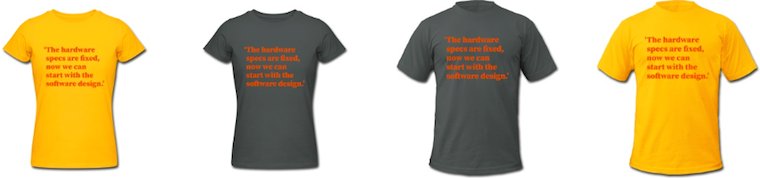
I found out at the very end, when I got to check it out (typical, eh), that you can change the shirt colour in the shop. Suits me fine; a simple ‘menu’ to choose from and then freedom to customise, a bit.
When I checked the wishful thinking topic page, I noticed how hard‐hitting these are by themselves, so it was clear that these go, solo, on the front:
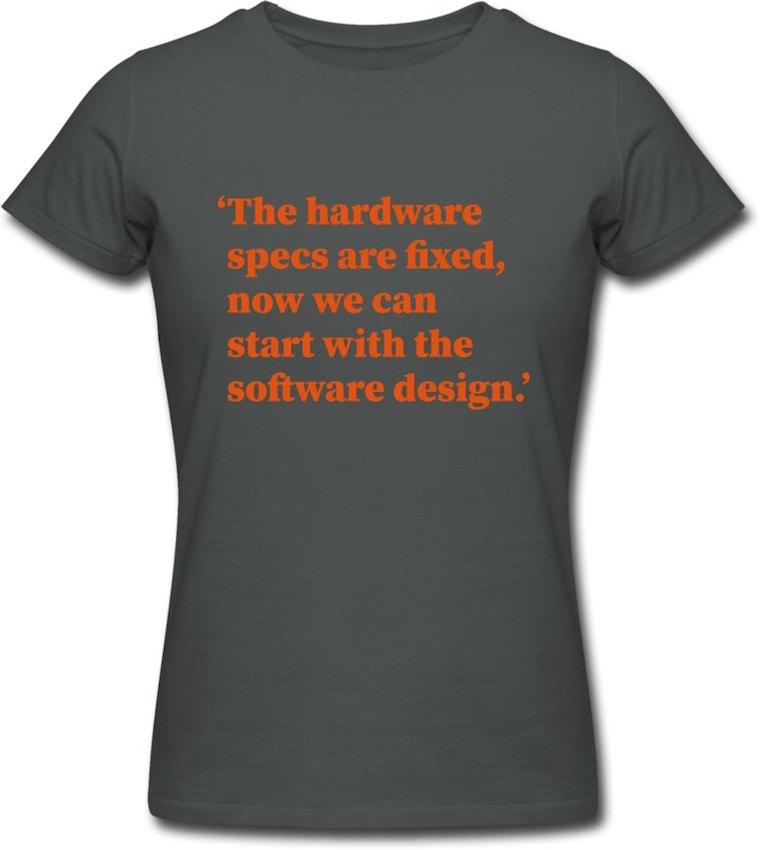
This is the wishful thought for August ’15 and you can see that I plunged for the first one I saw. Each month I will pick a different one (no, not in the order on that page) and change the ‘bright’ colour scheme.
On the back we ensure that everyone gets the point…
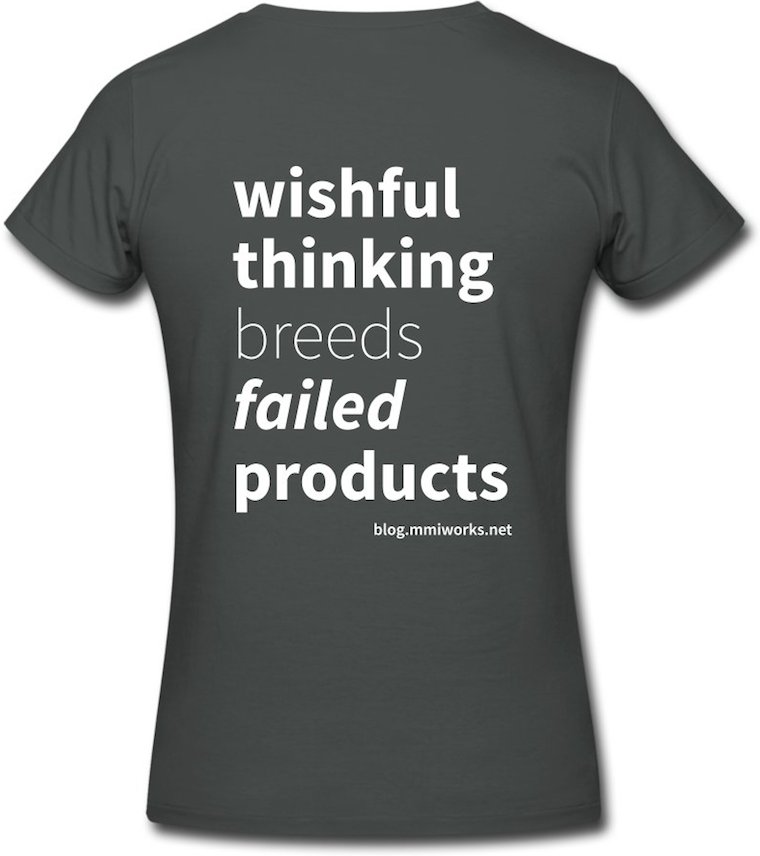
…just in case the beholder wishfully thinks the statement on the front is best‐practice.
postscript
And out of the blue m+mi works offers a hardware product. It will be fun offering these and I hope spreadshirt cooperates a bit more to keep it that way. I look forward to seeing one of these t‑shirts being worn in the wild.
Labels: act to succeed, top story, why products fail



a half‑century of success
11 June 2015, 12:48
To complete the round number of fifty, I present the final dozen + two of these for your reference. If you are a product maker, or manage a product‐shipping organisation, then you can initiate at least one of these today:
Make the lead designers of your hard‐ and software work as a pair; make them inseparable.cf. ‘The hardware specs are fixed, now we can start with the software design.’
Define your focus so tightly, it hurts (a bit); deploy it so you ship, instead of discuss.cf. ‘We spent ages discussing this, trying to find a solution that pleased everyone.’
Make interaction design the backbone of your product realisation; or compete on low, low price.cf. ‘We thought we could spend a couple of man‐days on the low‐hanging usability fruit.’
Deploy lightweight design and engineering documentation to keep everyone with the programme.cf. ‘The source is the ultimate documentation.’
Ban hacks, at least from those who are supposed to shape your product for the long term.cf. ‘There is no need to go for the gold‐taps solution.’
Set a ‘feature budget’ and set it way below bloat; be frugal, spend it on user value.cf. ‘It does not hurt to have those features as well.’
Set the goal to be competitive on each platform you support—that starts with your interaction.cf. ‘One code base; fully cross‐platform.’
Root out boilerplate thinking for any product aspect; your design process is your QA.cf. ‘You have to pick your battles.’
Set up your designers for big impact on the internals of your software, instead of vice versa.cf. ‘Once you get familiar with the internal workings of our software, it becomes easy to use.’
Define your target user group(s) so tightly, it hurts; focus on their needs, exclusively.cf. ‘Our specific target user group is: everyone.’
Introduce this KPI: the more your developers think the UI is ‘on the wrong track,’ the better.cf. ‘Our developers are very experienced; they make the UI of their modules as they see fit.’
Hire those who are able to take your interaction beyond the HIG, once you achieve compliance.cf. ‘We religiously adhere to the HIG.’
Regularly analyse workarounds adopted by your users; distill from them additional user needs.’cf. ‘You can do that by [writing, running] a script.’
Make the connection: product–users–tech. Design is the process, the solution and realisation.cf. ‘What do you mean “it’s all connected”? we just don’t have the time for those bits and pieces.’
ask not what this blog can do for you…
Now, what else can you do? First of all, you can spread the word; share this blog post. Second, I invite you to connect via twitter, g+, linkedin, or xing.
And third, if you able and willing to take some positive action, then email or call us. We will happy to help you ship successful products.
ps: you can check out part three if you missed it.
Labels: act to succeed, practical, top story
12 things you can do to succeed, enterprise edition
30 January 2014, 11:54
Part three of the mini‐series I am running at the moment on the usual social channels—twitter, g+, linkedin and xing—called positive action ships successful products. There, for every wishful thought that persists in the (mobile) software industry, I supply a complementary positive action.
:
Better go for it, deploy user research and design to ensure that new is really better.cf. ‘Better play it safe, because it has not been done before.’
Better go for it, ban meetings; get the makers to collaborate in (pairs of) pairs.cf. ‘Better play it safe, so it won’t cause all these extra rounds of meetings.’
Better go for it, evangelise the new, listen carefully to any needs, ignore naysayers.cf. ‘Better play it safe, because the first feedback was rather reserved.’
Better go for it, make it an offer that can’t be refused—if it gets nixed, go underground.cf. ‘Better play it safe, so we get the OK.’
Better go for it, negotiate until you trust that the engineers can build the design.cf. ‘Better play it safe, because the engineers say it cannot be done.’
Better go for it, it is faster to build a completely new core product from scratch.cf. ‘Better play it safe, because that code base is spaghetti.’
Better go for it, and enjoy every minute; save time through structure, research + design.cf. ‘Better play it safe, so we all can go home at five—and on 14:30 (D) / to the pub (GB) on friday.’
Better go for it, because the blame will fall on us anyway.cf. ‘Better play it safe, because the blame will fall on us.’
Better go for it, once the core product blows away the competition, features can be added.cf. ‘Better play it safe, so we have time for more features.’
Better go for it, use frequent user testing to debug the innovative design.cf. ‘Better play it safe, to pass the usability test.’
Better go for it, define a new game, on your terms, and ditch them old millstones.cf. ‘Better play it safe, to pass the regression test.’
Better go for it, model careers are built on delivering remarkable results.cf. ‘Better play it safe, to not jeopardise my promotion.’
ask not what this blog can do for you…
Now, what else can you do? First of all, you can spread the word; share this blog post. Second, the series continues, so I invite you to connect via twitter, g+, linkedin, or xing, and get a fresh jolt of positive action every workday.
And third, if you able and willing to take some positive action, then email or call us. We will happy to help you ship successful products.
ps: you can check out part two if you missed it.
Labels: act to succeed, practical
another 12 things you can do to succeed
9 January 2014, 19:08
Below I list the second dozen pairs of these for your reference. If you are a product maker, or manage a product‐shipping organisation, then you can initiate at least one of these today:
Identify the different nature/vibe of your product modules and flows; design them accordingly.cf. ‘A list is a list is a list. Why do these two parts of our app need such a different design?’
Hire a (lead) designer whose career is longer than that of your most senior developer (and the CTO).cf. ‘Sure, it needs to be designed. Let’s get a [student, intern] for that.’
Tackle usability from the core outwards: how your product works; stop tinkering on the fringes.cf. ‘Our usability sucks. To fix that, maybe we can take some guidelines and apply them religiously.’
Erect a chinese wall between your product and the customer wishes you are forced/paid to build.cf. ‘The features our most‐valued customers ask for are implemented asap, future plans be damned.’
Start your development cycle by structuring it with your designer(s); serious work starts then.cf. ‘The development is almost finished, now we need some design on top to jazz it up.’
Celebrate that your organisation is an exclusive group of insiders; real users are out there.cf. ‘We are the typical users.’
Plan with a single, integral solution from your designer(s), which gets continuously refined.cf. ‘Let’s get the designer(s) to deliver 3 proposals, then we pick—and mix—what we like.’
Refuse to get your data separated from the value your product delivers.cf. ‘For that you can export the data to excel.’
Hire user researchers to map out how your core users tick and what their needs are.cf. ‘We did do user research; we asked them what they liked and not, and what was missing.’
Fight rust; regularly identify product areas that were stable for years and redesigned them.cf. ‘We have been doing it like this for many years.’
Stamp out the tinkering; get it designed, completely—no holes; documented nimbly, ‘on paper.’cf. ‘We design in code.’
Hog effort, your organisation deals with it; your users get to do their thing, effortlessly.cf. ‘Really, users could also put some effort into using our software.’
ask not what this blog can do for you…
Now, what else can you do? First of all, you can spread the word; share this blog post. Second, the series continues, so I invite you to connect via twitter, g+, linkedin, or xing, and get a fresh jolt of positive action every workday.
And third, if you able and willing to take some positive action, then email or call us. We will happy to help you ship successful products.
ps: you can check out part one if you missed it.
Labels: act to succeed, practical
12 things you can do to succeed
18 December 2013, 09:50
‘Stop the wishful thinking and get on with some positive action.’ That is what I was thinking when I wrapped up the mini‐series wishful thinking breeds failed products on the usual social channels—twitter, g+, linkedin and xing.
Below I list the first dozen pairs of these for your reference. If you are a product maker, or manage a product‐shipping organisation, then you can initiate at least one of these today:
Drive your market, beyond your customers’ wildest dreams; stamp out any reactive thinking.cf. ‘Just ask the customers, they know best.’
Establish technology selection processes where the driver is user value delivery.cf. ‘Users will love our hot, new technology, they will be queuing around the block.’
Institutionalise QA beyond bugs—of design; its execution; usability; of your communication.cf. ‘With zero (major) bugs in the tracker, this feature must be working well.’
Improve your product—just because you know it can be done better: design it, test it, ship it.cf. ‘But why? nobody ever complained about that.’
Pick the right defaults for your product; let users configure it by ‘just putting it right.’cf. ‘We’ll leave that choice to our users, via a setting in the preferences.’
Get the usability right early on, then follow through on the design details to the very end.cf. ‘In this phase of development, usability is a nice‐to‑have.’
Establish a design department, working at eye‑level with product management and engineering.cf. ‘Our product designers are part of the [marketing, engineering, product, operations] department.’
Improve the status quo—because you know it can be done better: design it, test it, ship it.cf. ‘This is what users are used to; we better not change it.’
Stamp out any notion that making your product is somehow directly related to using it.cf. ‘We started out by scratching our itch; today, we still make it exactly how we like it.’
Consistently feed qualitative data into your design process; leave numbers to bookkeepers.cf. ‘With all this quantitative tracking data, we know exactly what works, and what not.’
Plan every version—major and dot—around increased user value; the rest follows from that.cf. ‘For our next version, we will refactor a lot of the code; a huge effort, so no other changes.’
It is your market, you design what is right for it—in an ever‐changing world.cf. ‘I can’t see why we would do it differently from how [facebook, microsoft, google, adobe] do it.’
ask not what this blog can do for you…
Now, what can you do? First of all, you can spread the word; share this blog post. Second, the series continues, so I invite you to connect via twitter, g+, linkedin, or xing, and get a fresh jolt of positive action every workday.
And third, if you able and willing to take some positive action, then email or call us. We will happy to help you ship successful products.
Labels: act to succeed, practical
If you like to ask Peter one burning question and talk about it for ten minutes, then check out his available officehours.
 Peter Sikking is an
experienced
Peter Sikking is an
experienced
interaction architect. He unabashedly puts
shipping great products at the centre of his design practice. He is known for
his work for Google, Nokia, the
Metapolator &
GIMP
open source projects,
and startups.
What is Peter up to? See his /now page.
- info@mmiworks.net
- +49 (0)30 345 06 197
- imprint